Food & Agriculture
Food supply chains, agricultural trade, Ukrainian Sea Corridor, Grain from Ukraine, roadmaps and food trade facilitation.
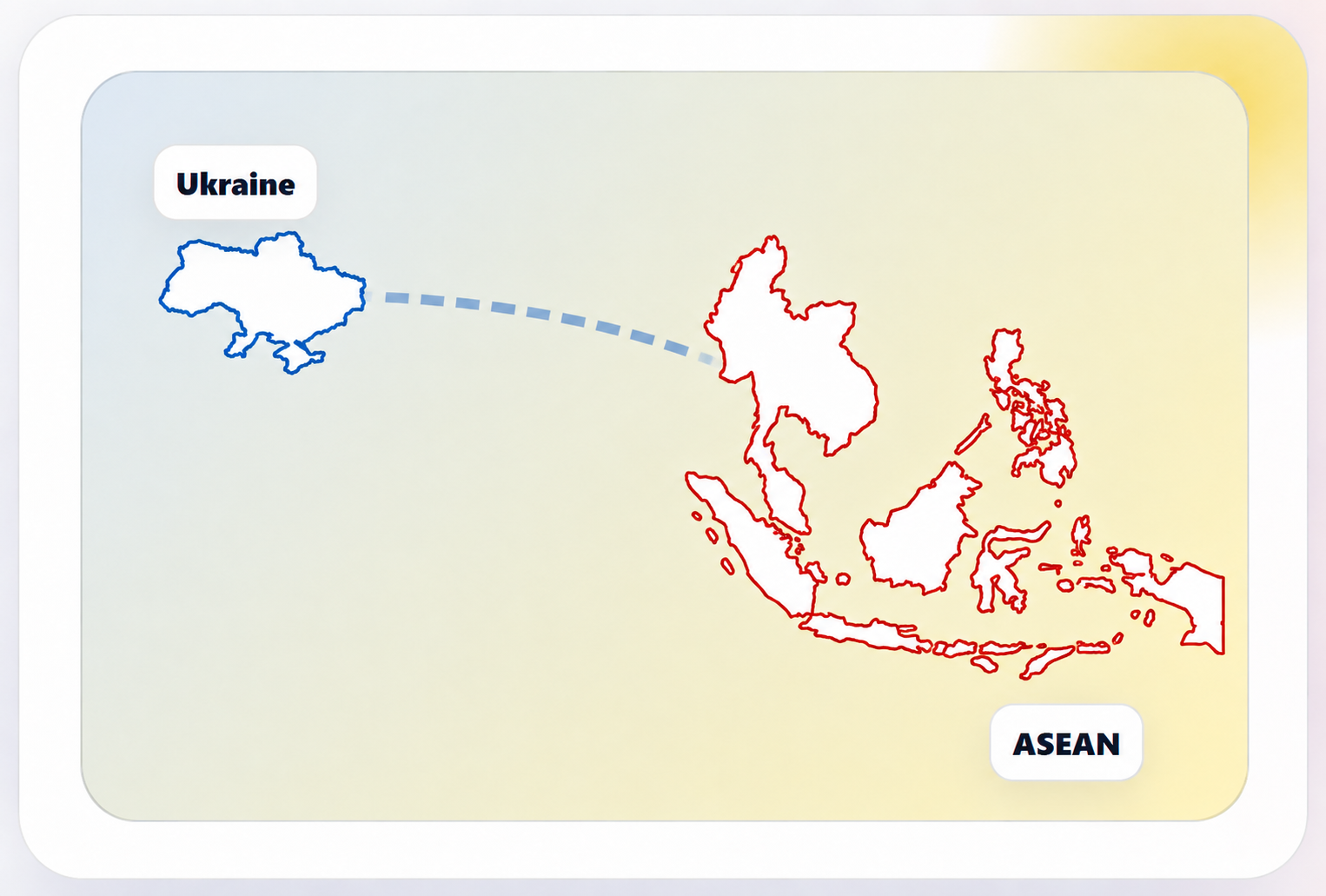
A data-driven digital platform for diplomacy, food security, digital transformation, trade, energy resilience, reconstruction, demining, culture and people-to-people cooperation between Ukraine and Southeast Asia.
Data version: compiled for portal update on 24 June 2026. Trade figures should be verified with the State Customs Service of Ukraine BI or official UN Comtrade API before formal publication.
The previous booklet statistics were updated with newer open-source figures and a 2024 Ukraine–ASEAN trade extract. These indicators can be used as the portal’s new data layer.
Source notes used for this update: ASEANStats / ASEAN Secretariat, UN Comtrade-linked trade pages and compiled extract, State Customs Service of Ukraine BI reference, MFA of Ukraine, World Bank RDNA5, IEA, IAEA/OECD-NEA, UNESCO and humanitarian demining open data.
The portal keeps the historical milestones from the original vision booklet and updates the political status for 2026.
ASEAN acknowledged the first Ambassador of Ukraine to ASEAN.
The Parliament of Ukraine obtained Observer status in the ASEAN Inter-Parliamentary Assembly.
The ASEAN Research Centre in Ukraine was established.
ASEAN member states reached consensus on Ukraine’s accession to the Treaty of Amity and Cooperation in Southeast Asia.
The Parliament of Ukraine ratified Ukraine’s accession to the TAC.
Ukraine continues to seek deeper institutional cooperation with ASEAN, including the status of Sectoral Dialogue Partner. The portal should use careful wording: “Ukraine seeks to obtain” rather than “Ukraine has obtained”.
The updated portal preserves the original seven cooperation tracks and adds a stronger data layer for each track.
Food supply chains, agricultural trade, Ukrainian Sea Corridor, Grain from Ukraine, roadmaps and food trade facilitation.
Diia, IT exports, cybersecurity, e-services, digital literacy, GovTech, 5G and threat intelligence.
2024 Ukraine–ASEAN trade extract, B2B exchanges, customs cooperation, certification and trade routes.
Energy resilience, gas storage, nuclear safety, renewables, efficiency and low-carbon technologies.
Preparedness, risk assessment, response, recovery, climate adaptation and institutional cooperation.
Mine action, marine demining, expert exchanges, technology, workshops and recovery of productive land.
UNESCO heritage, damaged cultural sites, creative industries, education, youth and people-to-people links.
Ukraine’s contribution to ASEAN connectivity and resilience through practical sectoral cooperation.
The old 2023 turnover figure was replaced by a compiled 2024 country-by-country extract. For official publication, verify it with UN Comtrade API or the State Customs Service of Ukraine BI.
In 2024, Ukraine–ASEAN merchandise trade was concentrated in Vietnam, Indonesia, Thailand and Malaysia. Food and agricultural products remain central to Ukraine’s exports to Southeast Asia, while imports from ASEAN include consumer goods, industrial products, electronics, palm oil, textiles and footwear.
Unit: US$ million, current value. Data compiled from public UN Comtrade-linked sources for the portal update.
| Rank | Partner | Ukraine exports US$ mn | Ukraine imports US$ mn | Turnover US$ mn | Balance US$ mn | Share |
|---|---|---|---|---|---|---|
| 1 | VietnamVNM | 263.52 | 620.21 | 883.73 | -356.69 | 32.16% |
| 2 | IndonesiaIDN | 520.74 | 232.54 | 753.28 | 288.20 | 27.42% |
| 3 | ThailandTHA | 172.02 | 277.50 | 449.52 | -105.48 | 16.36% |
| 4 | MalaysiaMYS | 111.09 | 317.17 | 428.26 | -206.08 | 15.59% |
| 5 | PhilippinesPHL | 12.26 | 57.34 | 69.60 | -45.08 | 2.53% |
| 6 | SingaporeSGP | 38.45 | 23.29 | 61.74 | 15.16 | 2.25% |
| 7 | MyanmarMMR | 0.47 | 49.57 | 50.04 | -49.10 | 1.82% |
| 8 | CambodiaKHM | 2.55 | 42.82 | 45.37 | -40.27 | 1.65% |
| 9 | LaosLAO | 0.31 | 5.46 | 5.77 | -5.15 | 0.21% |
| 10 | Timor-LesteTLS | 0.02 | 0.08 | 0.11 | -0.06 | 0.00% |
| 11 | BruneiBRN | 0.00 | 0.06 | 0.07 | -0.06 | 0.00% |
Methodological note: this table is a portal-ready extract based on public UN Comtrade-linked pages and should be treated as a working dataset. The strongest official version should be produced from the State Customs Service of Ukraine BI export or UN Comtrade API with Ukraine as reporter and all 11 ASEAN partners.
The old Black Sea Grain Initiative statistics are now treated as historical data, while the portal foregrounds the Ukrainian Sea Corridor and Grain from Ukraine.
120mn+ tonnes of cargo had moved through the Ukrainian Sea Corridor by May 2025, including approximately 76mn tonnes of agricultural products.
The programme mobilised around US$220mn in support and delivered Ukrainian grain to countries facing food insecurity, including more than 170,000 tonnes of wheat in the official programme reporting.
Ukraine harvested about 56.7mn tonnes of grain in 2024, including about 22.6mn tonnes of wheat. Wheat output in 2025 was estimated around 23mn tonnes.
Ukraine’s digital sector is one of the strongest cooperation tracks for ASEAN: it combines a mature IT export industry, practical e-government experience and wartime digital resilience.
The energy block was updated to avoid outdated ranking claims and focus on precise resilience, storage and nuclear safety indicators.
Ukraine’s energy system remains a key element of European energy security, with one of Europe’s largest underground gas storage systems and major experience in maintaining energy resilience under wartime attacks.
Ukraine has a major civil nuclear energy sector, while the Russian occupation of Zaporizhzhia NPP has created unprecedented nuclear safety and security challenges.
Energy security, renewable and alternative energy sources, energy efficiency, safety standards, low-carbon technologies and conservation practices.
The reconstruction block now uses the latest RDNA5 headline estimates and can be used to invite ASEAN partners into specific recovery sectors.
Ukraine’s reconstruction is not only about rebuilding what was destroyed. It is also about creating a modern, resilient, innovative and future-oriented European country with opportunities for responsible international partners.
Housing, transport and energy remain among the most heavily affected sectors. ASEAN companies can explore infrastructure, logistics, healthcare, digital solutions, agriculture and green recovery.
The destruction of the Kakhovka Dam caused nearly US$14bn in estimated damage and losses, with recovery needs of around US$5.04bn.
Ukraine can share experience in disaster prevention, mitigation, risk assessment, monitoring, preparedness, response, recovery and rehabilitation in uncertain times.
The older 174,000 km² and US$37.4bn estimates were replaced with newer 2025–2026 mine action estimates.
Open assessments indicate that every US$1 invested in humanitarian demining can generate up to US$4 in economic return by restoring land, livelihoods and infrastructure.
Cooperation with the ASEAN Regional Mine Action Center, marine demining, post-conflict and disaster-affected areas, technology and innovation.
Consultations, workshops, expert exchanges, skills training and joint knowledge products on demining best practices.
The culture block now combines positive heritage diplomacy with an updated picture of cultural damage caused by Russia’s war against Ukraine.
Events, exchanges, festivals, art exhibitions, public library cooperation, university links and greater awareness of traditions, heritage and cultures.
Crimean Tatar–ASEAN intercultural dialogue, creative industries, cuisine, music, craft, youth cooperation and direct university collaboration.
Whether you represent a business, university, media outlet, government institution or civil society organization, the Ukraine–ASEAN Gateway can help connect you with the right Ukrainian partners.